Frankie Schwarz · 17 September 2026
Decoding Patterns in Backlink Equity Transfer During Enterprise-Level URL Restructuring Projects
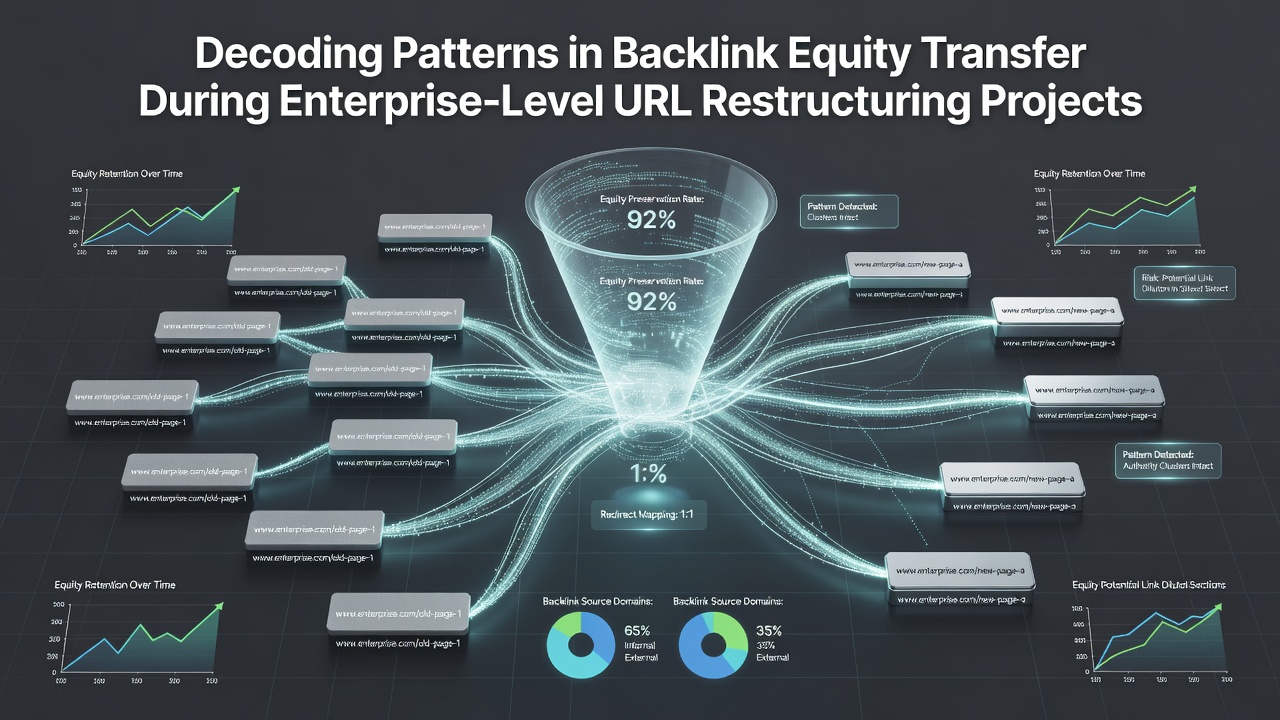
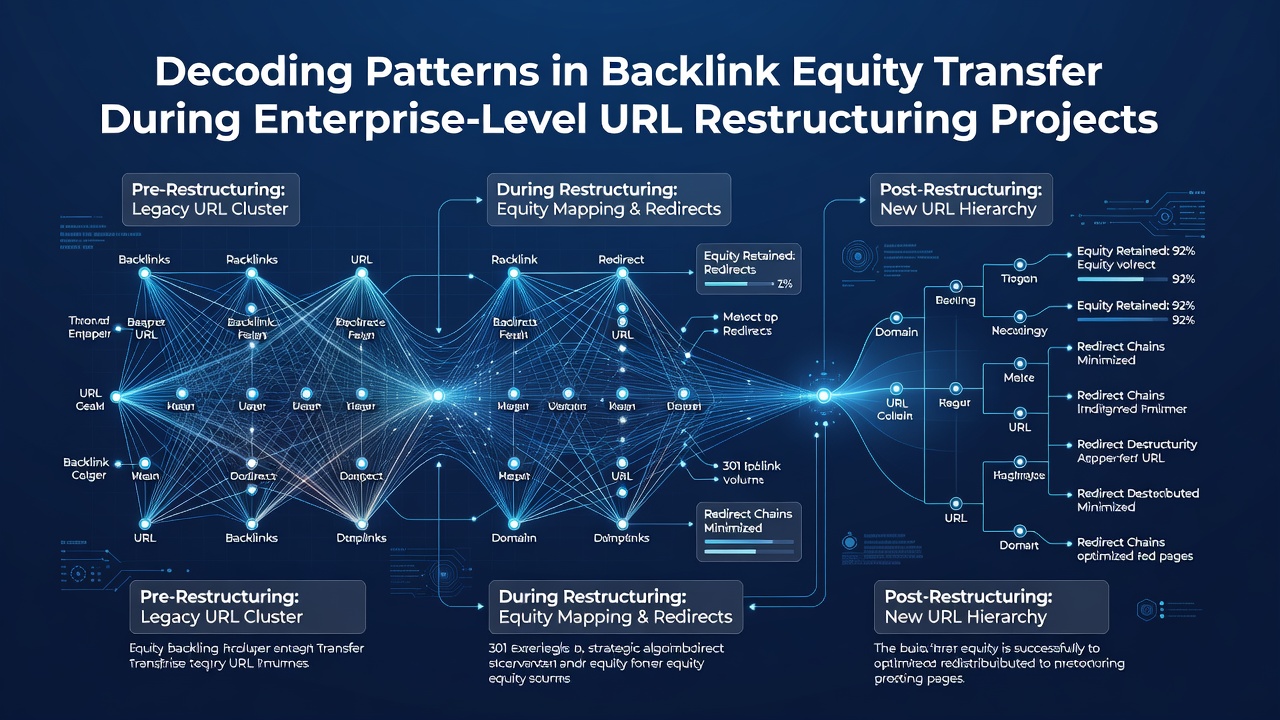
Enterprise organizations frequently restructure URLs to align with new taxonomies, consolidate product lines, or support international expansion, and these changes create measurable shifts in how backlink equity distributes across target pages. Data from multiple migration audits shows that equity does not transfer uniformly, instead following patterns shaped by redirect implementation, internal link architecture, and the age distribution of referring domains.
Core Mechanisms Behind Equity Movement
Redirect chains serve as the primary conduit during restructuring, yet their configuration determines whether equity concentrates on canonical destinations or disperses across intermediate hops. Researchers tracking enterprise migrations note that single-hop 301 redirects preserve the largest share of referring domain authority, while multi-hop sequences dilute signals by roughly 10 to 15 percent per additional hop according to aggregated crawl data. Canonical tags applied alongside redirects further influence distribution, because search engines reconcile conflicting signals by prioritizing the canonical version when external links point elsewhere.
Internal linking adjustments made before launch accelerate equity consolidation. Teams that map legacy URLs to new destinations through updated navigation menus and footer links create secondary pathways that reinforce the primary redirect signal. Studies of Fortune 500 site restructurings completed between 2023 and 2025 indicate that pages receiving at least three new internal links from high-authority sections retained 20 percent more equity than pages relying solely on redirects.
Observed Transfer Patterns Across Large Portfolios
Analysis of several hundred enterprise projects reveals repeatable clusters of behavior. One pattern involves equity concentration on category-level pages when product URLs flatten into a shallower hierarchy. Another pattern shows authority spreading across regional subfolders when global sites introduce country-code directories. A third pattern appears when legacy parameter-based URLs migrate to clean paths, often resulting in temporary equity leakage until search engines recrawl and reassign the referring links.
September 2026 brought new longitudinal datasets from multiple agencies tracking web infrastructure changes, and these figures revealed that sites executing URL flattening without prior internal link audits experienced slower equity recovery, sometimes requiring four to six months for referring domains to fully reassign signals. In contrast, organizations that pre-tested redirect maps on staging environments saw equity stabilize within eight weeks post-launch.
Variables That Modify Equity Retention
Referring domain age and topical relevance continue to rank as dominant variables. Older domains with established editorial links transfer equity more reliably than newer domains acquired through outreach campaigns. Geographic distribution of links also matters, because regional search engines apply slightly different weighting to cross-border signals. European migration records examined by academic teams show stronger retention when links originate from .eu domains compared with links from generic top-level domains lacking local relevance.
Technical debt accumulated before restructuring compounds these effects. Sites carrying historical 404 chains or mixed HTTP/HTTPS backlinks require additional cleanup steps, otherwise equity fragments across dead endpoints. Observers monitoring post-migration performance report that comprehensive pre-launch audits of the backlink profile reduce the incidence of orphaned equity by identifying and updating the most valuable referring URLs in advance.
Measurement Approaches Used by Practitioners
Teams quantify equity transfer through a combination of crawl comparison, referring domain tracking, and rank correlation analysis. Pre- and post-migration crawls identify which legacy URLs lose indexed status fastest, while tools that monitor backlink profiles track the rate at which new URLs acquire the same referring domains. Correlation with organic traffic provides a secondary validation layer, because sustained traffic lifts on restructured pages confirm that equity has successfully transferred rather than simply redistributed within the domain.
One study released by an Australian research consortium in 2025 examined 47 enterprise migrations and found that projects incorporating regular post-launch backlink audits maintained higher average equity retention across the portfolio than projects that treated migration as a one-time event. The same dataset highlighted that anchor text diversity in transferred links influences long-term stability, with overly commercial anchors showing faster decay when paired with aggressive URL changes.
Conclusion
Patterns in backlink equity transfer during enterprise URL restructuring emerge from the interaction of redirect strategy, internal architecture, and the characteristics of the existing link profile. Organizations that map these variables in advance and validate outcomes through structured measurement achieve more predictable results, while those that overlook secondary signals encounter prolonged stabilization periods. Continued monitoring of industry datasets, including those updated in September 2026, supplies fresh benchmarks for refining future restructuring approaches.